A Rethinking of Adam Smith’s “The Wealth of Nations” So who was Adam Smith? Adam Smith's version of...

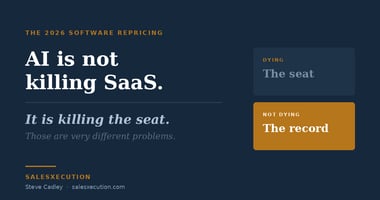
AI is improving how customers buy faster than sellers are adapting to sell, and bolting it onto an inside-out revenue system only produces a faster wrong answer at a lower cost per unit. Everyone feels more productive while the win rate stays flat.
SalesXecution redesigns the system underneath.
We are human-based change management with a deeply technical practice, and we play from go-to-market through to operational excellence.
The hard part of an AI transformation was never the model. It is getting an organization of people to change how it works and then making that change hold after the consultants leave, which is a different discipline from systems integration and the one we actually practice.
The problem is almost never the model. It is the system the model was dropped into.
Internal stages, static ICPs, activity metrics, territory math set at an offsite eleven months ago. None of it was stupid when it was built. It was a workaround for scarcity: too little data, too little coaching time, and no way to personalize at volume. Digital intelligence removed the scarcity, but the workaround stayed.
Buyers now run their own research and reshape their requirements somewhere between your first call and your second. Every methodology on your shelf assumed a slower-moving buyer than the one that now exists. Your funnel is a photograph of a market that has already moved.
Pushing more activity through the same broken motion is mechanization, and it is easy to mistake for progress. Growth that still requires linear headcount earns a services multiple, while growth that comes from an intelligence-native revenue system earns an asset multiple. Scalability is a valuation question before it is an operations one.

Data Integrity. Can we trust the revenue data? Record completeness, ownership, duplicates, stale deals, association quality, property sprawl. A model with clean reasoning and dirty context produces confident wrong answers at scale, which is worse than no answer at all.
Process Integrity. Does the sales process reflect how customers actually buy? Stage definitions, entry and exit criteria, handoffs, lifecycle logic. Most pipelines describe how the company thinks deals progress, not how buyers actually decide.
Methodology Integrity. Is the sales methodology actually operating in daily seller behavior? You already bought SPIN, Challenger, MEDDIC, Strategic Selling or Sandler, and the problem was never the methodology itself. It is that the methodology lives in a binder while the CRM lives somewhere else. We do not replace it, we make it executable.
Agent Readiness. Can AI safely and effectively support sellers, managers and leaders? CRM context quality, prompt and workflow design, conversation capture, human review rules, risk controls. Agents inherit the system they are dropped into. They do not inherit your judgment.


Performance Governance. Can leadership measure and sustain execution quality? Dashboards, coaching cadence, forecast inspection, adoption metrics, executive review. Without this, every improvement decays back to where it started within two quarters.
Data first. Process second. Methodology third. Agents fourth. Governance always.
Each check scores from 1 to 5, and we publish the bands rather than keeping them in-house. Below 3.0, deploying AI into the revenue system increases risk rather than performance, and we will say so.

Go-to-market is where market reality hits an organization first and hardest, which makes it the fastest place to find out whether an AI transformation is real or theater. It is also where the money is. So that is where we enter.
Broken handoffs, unreliable data, undocumented judgment, and change that will not stick are the same problems in service delivery and operations, and we work there too, because those functions determine whether the go-to-market promise is actually kept.
Finance and supply chain feel the impact of this work, but they are their own specialisms with their own experts. We partner with firms who live there rather than pretend we do.


Diagnose. Run the five gates against your revenue system. Platform-neutral, evidence-based, and it ends in a finding, not a proposal.
Remediate. Close the gates that are shut. This is usually data, definitions, and process before it is ever a model.
Activate. Build the layer that turns the repaired system into working intelligence, including conversation capture, methodology orchestration, and agent design.
Govern. Make the change hold. Ownership, cadence, and measurement, so the system does not drift back within two quarters.
We are eleven people with two to three decades each in revenue leadership, operations, organizational development and enablement, who happen to be building one of the deeper applied AI practices in the market.
That order matters. The hard part of an AI transformation was never the model. It is getting an organization of people to change how it works and then making that change hold.
Every person has run the function they now advise on.
Real numbers from a real revenue system, the week before someone wanted to deploy an AI agent into it.
Deal owners who no longer work there. Stage definitions nobody had audited since onboarding. This is not an unusual environment. It is the median one.
An agent dropped into this inherits all of it. It does not inherit your judgment.
Working with SalesXecution has been a game changer for our organization. Their AI-driven insights into our sales processes have significantly increased our productivity and helped us meet our revenue targets consistently. Their expertise in transforming our sales culture into a performance-based environment has been invaluable.
SalesXecution provided us with a tailored approach to tackle our unique challenges. The consultant's deep understanding of AI transformation and organizational culture enabled us to become trusted advisors to our clients, resulting in stronger relationships and increased trust. We couldn't have achieved this without their guidance.
The transformation we experienced with SalesXecution was beyond our expectations. Their ability to pinpoint productivity gaps and offer precise solutions has reinvigorated our sales team. The Simple Academy approach they implemented has empowered our team with the skills necessary to excel in today's competitive market.

The assessment is platform-neutral. It runs the same on Salesforce, Dynamics or HubSpot, because the questions are about your revenue system rather than your vendor.
Where we build, we are opinionated. A revenue system needs one system of record, and we went deep enough on HubSpot to become a Solutions Partner because half-implemented CRM is the most common root cause we find. Where a client is standardized elsewhere, we architect to that.
On models, our bench is certified on Claude. Client work runs on whatever your organization has standardized on. We are not reselling a model. We are designing the system it operates inside.
Signal capture. Fathom covers the digital conversation layer most CRMs never record, while Plaud, Limitless and Otter cover the field and face to face half.
Alpharetta, GA 30005
+1(475) 271-1846
Essays on revenue architecture, methodology, and what actually changes when an organization rebuilds instead of automating. One idea per issue, no digest of links.